- Home
- Swans in Canada
- Mute Swan
The Mute Swan: Why this Beauty is also a Beast
The Mute Swan (Cygnus Olor), most commonly known amongst the swan species, was introduced into North America by Europe and Asia in the late 1800s to grace the ponds of parks, estates, and zoos. For some, they're a loved symbol of serenity in city parks across Canada... Then they started escaping and establishing breeding populations in several areas, where their aggressive behaviour is threatening native waterfowl.
Description and Facts
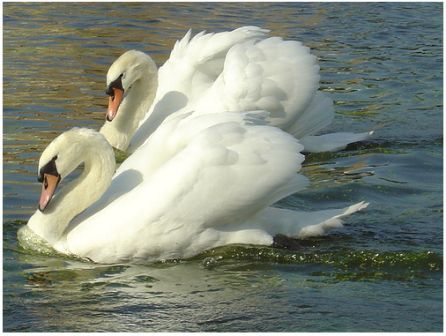
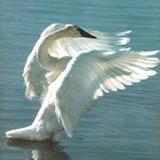
The Mute Swan is smaller than the Trumpeter Swan, but larger than the Tundra Swan. Unlike the other two species, it has an orange bill and a black face. The S-shape of its long neck is more defined than that of the other two species.
Their wings are also more raised and their bill is pointing downwards as they swim, which gives them a more majestic look. Their size is between 127 - 152 cm (50 - 60 inches), with a wingspan of between 208 - 238 cm (82 - 94 inches), and a weight of 5,500 - 14,300 g (194.15 - 504.79 ounces). The male (cob) is slightly larger than the female (pen), and has a larger knob on its bill.
Though they're called Mute Swans, they are not mute at all. However, they earn this name due to their calls being quiet and not carrying very far.
Their flapping wings make a singing sound when they're in flight. During breeding season the male Mute Swan's bill swells and becomes noticeably larger than the female's.
Just like the Trumpeter Swan and the Tundra Swan, they're said to mate for life, but this is not always the case in Mute Swans. Some have been observed to have as many as four mates, or even "divorce" one mate in favour of another. In case of the death of a partner, they will find another partner.
The cygnets (baby swans) have two color morphs: a gray form and a white form. As adults they look alike, though the ones of the white morph may have pink or gray legs and feet instead of black.
These swans are most commonly found in the wild, in parks or on country estates. In the winter they are found on marine waters. They like to live in well-sheltered bays, open marshes, lakes, and ponds. They rarely nest in colonies. Breeding begins in March or early April. They either build a new nest or use a previously constructed mound. The large nest is made of aquatic vegetation, lined with feathers and down, and it's built well above the normal water level in swampy places near a pond or lake.
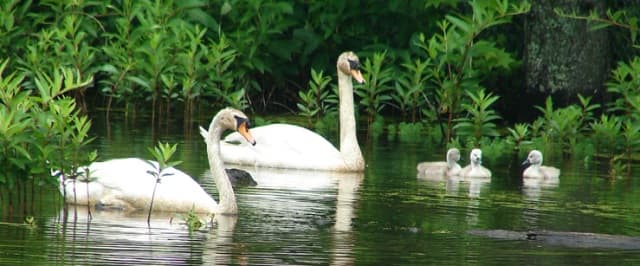
It is common for clutches of 5 to 7 to occur, but even 5 to 12 are possible. The eggs are pale gray to pale blue-green. Incubation lasts 36 to 38 days. The cygnets are brownish gray and only remain in the nest for one day. Within the next 12 months they gradually turn white.
The male (cob) may often take the first-hatched cygnet to the water while the female (pen) continues to incubate the remaining eggs.
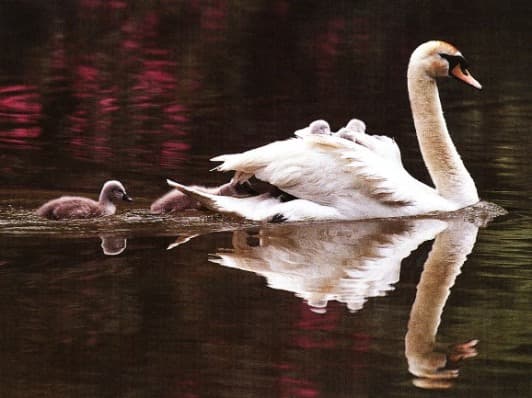
The
male Mute Swan is very protective of its
territory and its cygnets. In about 60 days cygnets
are able
to fly.
They can ride on the backs of their parents or under their wings. The
parents drive the young away by
the following breeding season. The
cygnets then join flocks of other non-breeding swans. During this
time they molt their feathers, making them flightless for a short
period of
time.
They begin to bond with a mate in the next two years, and start looking for suitable breeding territory. Swans do not begin to breed until about their third year.
The Trouble with Mute Swans
Presently there are about 25,000 of these swan species in the Great Lakes region, Chesapeake
Bay area and the North Atlantic coastal areas.
Considering that there were only about 1,000 of these swans in the
1950s, this is a huge jump in their population. They are very
aggressive and have been know to attack even humans who
come too close
into their territory; so native species of waterfowl are at
even
greater risk.
The lower Great Lakes region in Canada is of great
concern, as it is on the major migration path and is a wintering ground
for many native Eastern North American bird species. Mute Swans compete
directly with many of these species for food and desirable habitat. One
of these species is the Tundra
Swans, whose annual migration to and from Canada's Arctic
is one of the wonders
of nature
in Southern Ontario. Tundra swans are unable to find the food they need
to survive and can be driven away from their traditional wintering
areas. If the growth of Mute Swans is not contained, they may also
affect the Tundra Swan's use of migratory resting areas such as the
Great Lakes and migration resting areas.
Another source of
concern is the alarming rate at which Mute Swans are devouring and
destroying aquatic plants. According to a U.S. study a single swan is
capable of eating 8 pounds of vegetation in a day, and uprooting
another 20 pounds during the feeding process. This results in loss of
habitat and a key food source for other waterfowl and aquatic species,
including fish.
In Canada, populations of Mute Swans are being
closely monitored by the Canadian Wildlife Service (CWS), and Long
Point Waterfowl Researchers are monitoring their numbers in Lake Erie, Lake Ontario and Lake
St. Clair, using small airplanes. Surveys show that
between 2003 and 2005 the population had doubled from 1,373 to 2, 737
swans.
As
the Mute Swan has no natural predators to reduce their numbers, and
Ontario has no current management plan to reduce populations, their
numbers are expected to grow rapidly in Ontario's lower Great Lakes
area; the Canadian hotspot for the Mute Swan invasion. Fortunately this
invasion has not expanded yet into Western
Canada or the Maritimes. However, if something is not done
soon, this growing problem will become as huge as it has in the United
States.
The
Atlantic
Flyway Council is closely monitoring the swans.
It is composed of officials from the
state and provincial wildlife management agencies along an eastern
seaboard migratory zone, stretching from Florida to Ontario, Nunavet
and the Maritimes. The council is calling for a coordinated plan to
reduce populations to 3,000 swans by 2013, and increased efforts to
educate the public about the serious threat posed by Mute Swans.
Hopefully they will succeed in their goal; it's hard to picture these
beautiful swans as
being a threat to other waterfowl.
You might like these
Swans: The Trumpeter Swan and its Counterparts in North America
Three types of swans live in North America: the Trumpeter, the Tundra, and the Mute swan. Have a closer look at them.
The Tundra Swan; One of the Cute Arctic Animals
The Tundra Swan, once called the Whistling Swan, is known for its migration to the Arctic each spring to build their nests.
Swan Pictures and Videos
Enjoy a collection of swan pictures and videos and relax in a world of beauty and grace...
The Magnificent Trumpeter Swan; Largest Bird
The Trumpeter Swan has come a long way. From almost going extinct to a nice comeback, they are found mostly in the western parts of Canada and parts of the USA.




New! Comments
Have your say about what you just read! Leave me a comment in the box below.